
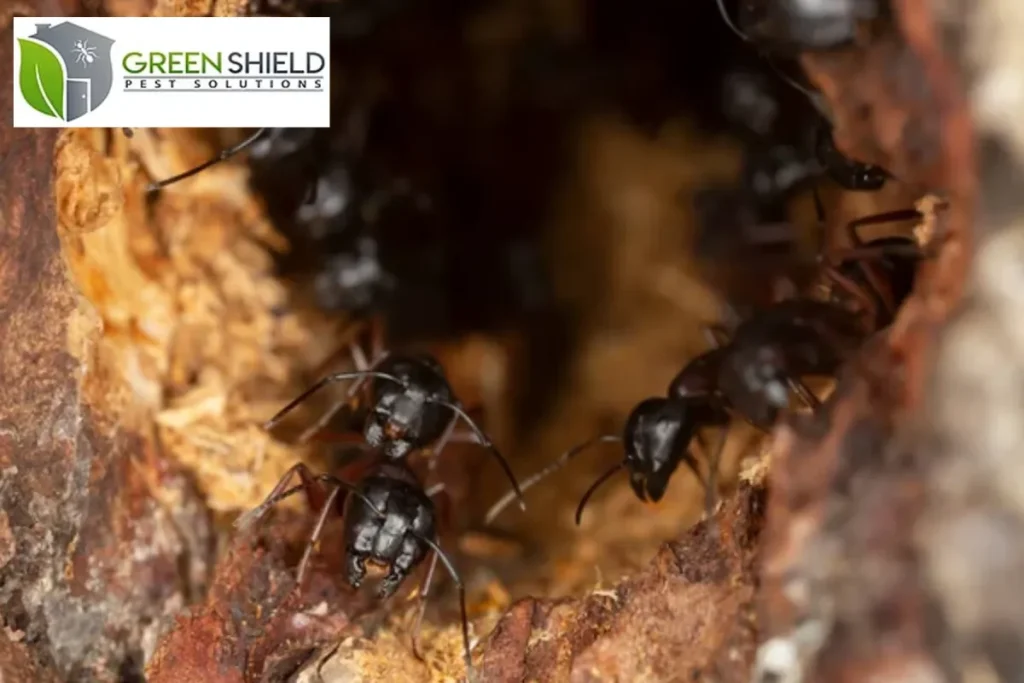
To distinguish between a carpenter ant foraging and a structural parent colony, observe the presence of frass; a parent colony produces localized piles of sawdust-like debris containing wood fibers and insect parts, whereas foraging involves clean trails of ants moving toward food sources. Furthermore, a structural colony is often evidenced by rustling sounds within wall voids or the appearance of winged swarmers indoors, while foragers are typically transient visitors in kitchens or bathrooms.
Understanding the Social Structure of Wood-Destroying Ants
Before you can accurately identify whether the ants in your home are simply visiting or have moved in permanently, it is essential to understand the complex social hierarchy of the carpenter ant (Camponotus). Unlike many other household pests, carpenter ants often maintain multiple nesting sites. This biological trait is what makes pest control in Lewiston, Maine, a specialized task that requires more than a simple surface spray.
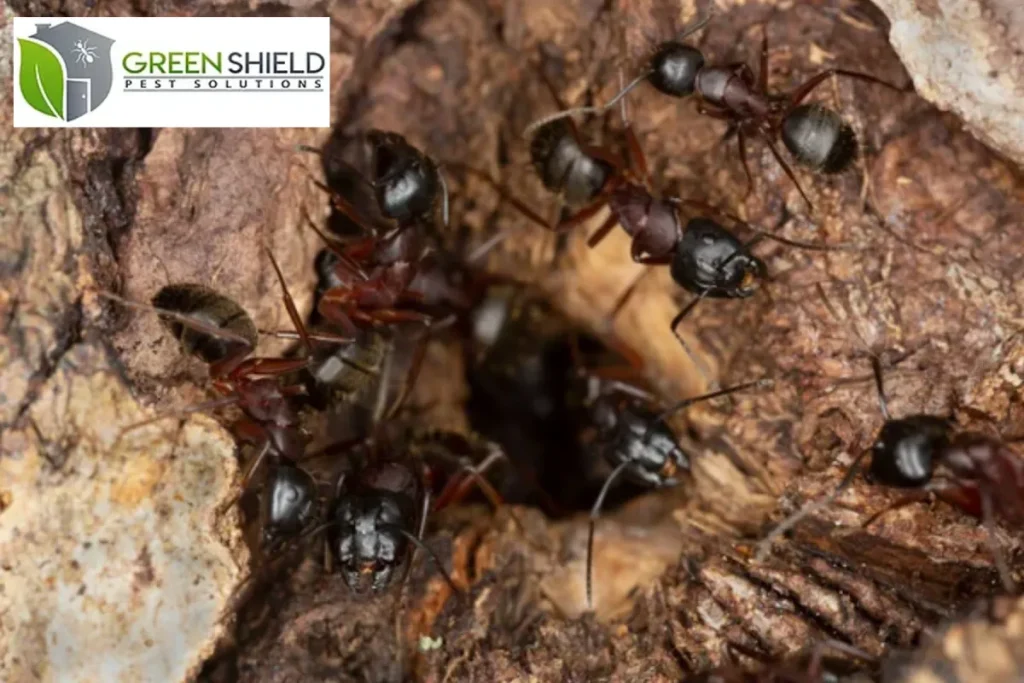
Carpenter ants establish moist “parent colonies” containing the queen and dry “satellite nests” for workers. Successful management relies on identifying whether ants are simply foraging from an outdoor source or have established a permanent structural residency.
Identifying Activity Patterns: Foraging Behavior
Foraging ants act as nocturnal scouts seeking food and water, often appearing in clean trails without the debris typical of a nest. During a recent audit, our trained professionals observed this classic behavior as ants trailed from a window to a pet bowl, a clear sign that a targeted innovative pesticide treatment is needed to intercept the colony before it establishes a permanent structural residency.
Signs Your Ants Are Just Foraging
- Trailing Behavior: Ants follow a distinct, invisible chemical trail to a specific food source (like sugar or grease).
- Clean Pathways: There is no “sawdust” or debris along the path the ants are taking.
- Transient Presence: You may see dozens of ants one night and none the next, depending on whether the food source has been moved or cleaned.
- Outdoor Entry Points: Foragers are often seen entering through window screens, under door sweeps, or through utility line gaps, suggesting their home base is outside in a nearby tree or woodpile.
Spotting the Signs of a Structural Parent Colony
A structural parent colony is a much more serious concern for the integrity of your building. This occurs when the ants have moved beyond foraging and have begun to excavate the wood within your home to create galleries. This activity can weaken structural beams over time, though they do not eat the wood as termites do; they simply remove it to make space.
In many residential neighborhoods, older homes with previous water damage are prime candidates for parent colonies. If you notice a consistent number of ants in the same area regardless of whether food is present, you may be dealing with a resident population.
Indicators of a Resident Colony
- Acoustic Signs: If you place your ear against a suspect wall in a quiet room, you might hear a faint “crinkling” or rustling sound. This is the sound of thousands of ants moving and working within the wood.
- Swarmers: The appearance of large, winged ants indoors is a definitive sign. These are reproductive ants looking to start new colonies, and their presence inside usually means a mature nest is located within the structure.
- Localized Activity: Seeing ants emerge from the same electrical outlet or baseboard gap every single day suggests a “kick-out hole” or nest entrance is nearby.
The Science of Frass: Analyzing the Evidence
Frass is perhaps the most reliable indicator used by an exterminator in Lewiston to confirm a nesting site. Because carpenter ants do not digest wood, they must dispose of the shavings they create while tunneling. They push this refuse out of small openings in the wood known as “kick-out holes.”
Comparison: Carpenter Ant Frass vs. Household Debris
| Characteristic | Carpenter Ant Frass | Common Household Dust/Lint |
| Composition | Shredded wood fibers and insect body parts. | Hair, skin cells, and clothing fibers. |
| Appearance | Looks like fresh, light-colored sawdust. | Grey, fluffy, or “dust bunny” appearance. |
| Insect Parts | Contains wings, legs, and heads of dead ants. | Generally absent. |
| Consistency | Found in a concentrated, conical pile. | Spread evenly or caught in corners. |
| Location | Directly beneath a crack or hole in wood/drywall. | Found throughout the home. |
If you find a pile of debris that looks like sawdust, look closely. If it contains the black or brown shiny bits of insect armor (heads, legs), it is almost certainly carpenter ant frass. This is a “smoking gun” that a colony is actively excavating your home’s structural members.
Applying Our Professional Methodology to Your Protection
At Green Shield Pest Solutions, we understand that discovering wood-destroying insects in your home can be stressful. To provide our clients with peace of mind, we utilize a two-pronged approach centered on our trained professionals and our innovative pesticide treatment.
The Role of Our Trained Professionals
Distinguishing a foraging trail from a parent colony requires the specialized expertise of our trained professionals. By identifying moisture signatures, structural vulnerabilities, and hidden frass, we ensure we treat the root source of the infestation rather than just the symptoms.
Our Innovative Pesticide Treatment
Once a structural colony is identified, we deploy our innovative pesticide treatment. Unlike traditional, repellent sprays that simply scatter ants and potentially cause the colony to “bud” or split, our treatment is designed to be undetectable. Our trained professionals apply a non-repellent transfer product.
This means the ants do not know they have come into contact with it. They carry the treatment back to the heart of the nest, sharing it with the queen and the larvae through a process called trophallaxis. This innovative pesticide treatment ensures the total elimination of the parent colony, providing a long-term solution that standard DIY fixes cannot achieve.
Why DIY Methods Often Fail for Wood-Destroying Insects
Many homeowners in various Neighborhoods attempt to resolve ant issues using over-the-counter baits or sprays. While these might kill a few dozen foragers in the kitchen, they rarely reach the parent colony hidden deep inside a wall void or a damp floor joist.
Repellent sprays can trigger “splitting,” causing colonies to relocate the queen and larvae to deeper, inaccessible areas. Our trained professionals avoid this by using an innovative pesticide treatment that eliminates the nest directly without scattering the ants, ensuring the problem is resolved rather than relocated.
Protecting the Health and Safety of Your Home
Our approach is built on the belief that your home should be a sanctuary. We prioritize the safety of your family and pets by using eco-conscious products that are specifically selected for their low environmental impact and high pest-control effectiveness.
For property managers and homeowners who are tired of the frustration caused by ineffective, short-term fixes, our personalized service plans offer a reliable alternative. By choosing pest control in Lewiston, you are choosing a partner that values transparency and customer satisfaction above all else. We want you to feel confident that your property is being handled by experts who truly care about the results.
People Also Ask
Does seeing one carpenter ant mean I have an infestation?
Not necessarily; it could be a lone scout from an outdoor nest. However, seeing them regularly, especially at dusk or near moisture-prone areas, suggests it is time for our trained professionals to inspect for frass and hidden satellite nests.
How do I know if I have carpenter ants or termites?
Termites consume wood and leave tiny, uniform pellets, while carpenter ants excavate it, leaving shredded “sawdust” (frass). Physically, carpenter ants have elbowed antennae and narrow waists, whereas termites have straight antennae and broad waists.
Can I get rid of a carpenter ant colony myself?
It is extremely difficult because parent colonies are often hidden deep within structural voids. Surface sprays are ineffective; total elimination requires our innovative pesticide treatment to reach the queen and stop the infestation at its source.
What attracts carpenter ants to a home?
Moisture is the primary attractant. Leaking pipes, clogged gutters, and poorly sealed windows create the damp, softened wood that these ants require to establish a thriving parent colony.
Secure Your Peace of Mind with a Free Inspection
Don’t let the stress of recurring infestations affect your quality of life. Whether you are dealing with a few foragers in the kitchen or have discovered a pile of frass in your basement, Green Shield Pest Solutions is here to provide the expertise and responsive service you deserve.
As your reliable partner, we combine local expertise with advanced strategies to ensure a clean, safe, and pest-free environment. Schedule a free inspection or request a quote today to experience how our trained professionals and innovative pesticide treatment provide the peace of mind and long-term protection your property deserves.
Ready to protect your property? Contact us today for professional pest control and experience the difference that personalized, expert care can make for your home or business.