
- Home
- About
- Pest Control
- Pest Library
- Maine
- Albion
- Augusta
- Belgrade
- Belgrade Lakes
- Chelsea
- China
- China Village
- East Winthrop
- Farmingdale
- Fayette
- Gardiner
- Hallowell
- Kents Hill
- Litchfield
- Manchester
- Monmouth
- Mount Vernon
- North Monmouth
- North Vassalboro
- Oakland
- Pittston
- Randolph
- Readfield
- Rome
- Sidney
- South China
- South Gardiner
- Vassalboro
- Vienna
- Waterville
- Newcastle
- Nobleboro
- Somerville
- South Bristol
- Southport
- Waldoboro
- Westport Island
- Whitefield
- Wiscasset
- New Hampshire
- Londonderry
- Newton
- Newfields
- Newmarket
- North Hampton
- Northwood
- Nottingham
- Plaistow
- Lee
- Madbury
- Milton
- Middleton
- Rollinsford
- New Durham
- Rochester
- Blog
- Feedback
- Contact
Bee and Wasp Control in Southern Maine
For safe and effective bee and wasp control in Southern Maine, trust Green Shield Pest Solutions. We apply treatment using green and safe pesticides to carefully manage stinging insects while keeping your environment secure and balanced.
Contact Us For a FREE Quote
Rated 5.0 ⭐⭐⭐⭐⭐
336 Google reviews
The experts at Green Shield Pest Solutions can exterminate any stinger pest infestation. These guys will use their stingers as a defense mechanism, but they vary widely in aggression and basic habits. Get bee control services in Saco, Portland, Wells & Cape Elizabeth, ME.
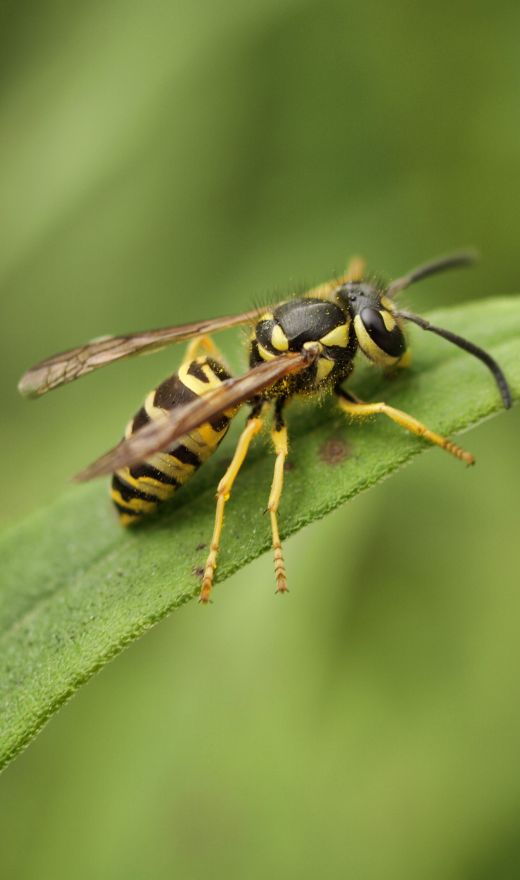
Yellow Jacket
Named after: Their yellow-looking jacket.
Identification: 3/8″-5/8,” black with yellow stripes
Seasonality: Summer and fall
Why they are in/near my home: They like to live where humans live and build their nests in a wide-variety of places, usually low to the ground. This includes abandoned animal burrows, hollow trees, rotting logs, and inside the walls of houses. They can also nest underground.
Tips for homeowners: They often scavenge for many types of food and are attracted to the odor of garbage cans and patios where human food is found outdoors. Keeping the exterior of your home clean is important.
How Green Shield can help: With such a wide variety of places they can build, Green Shield is an excellent source to discover and treat each nest. Often, they can be difficult to find due to some building underground cavities which are not always spotted easily when walking across your lawn. Yellow jackets can be aggressive and will protect their nests if threatened which can pose a danger to children unaware of their location.
Weird fact: There are 18 species of yellow jackets, many of which live in Maine.
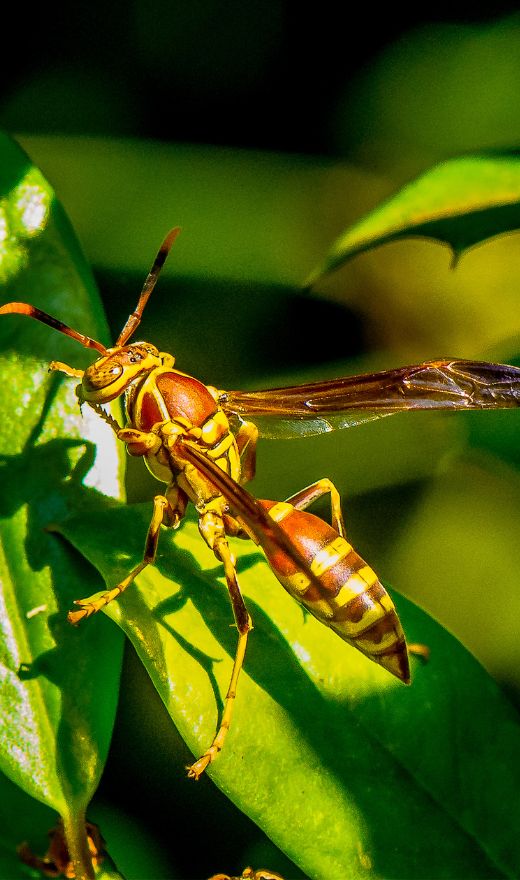
Paper Wasp
Named after: Their nests resemble a paper-like material made from saliva and plant fibers.
Identification: 5/8″-3/4″ brownish with yellow and sometimes red markings
Seasonality: Summer and fall (May-October)
Why they are in/near my home: The home acts as a sturdy base where they can build their home of paper-like material. In the fall, females will often seek shelter in unoccupied spaces in the home like the attics, dormers, and high ceilings. Flowers and plant-life will attract them to a home as well as sticky soda spills and crumbs.
Tips for homeowners: Make sure all garbage cans are covered and clean up crumbs and spills.
How Green Shield can help: They like building their nests in higher areas like eaves, soffits, and gutters. Green Shield’s 20 foot webster pole allows us to reach areas not accessible without considerable effort from the homeowner. Nests are removed in a safe, effective manner without endangering people or pests. Various control methods after identifying the pest are used to reduce their population significantly.
Weird fact: They are not aggressive at all like the bald-faced hornet but can sting if disturbed.

Bald-faced Hornet
Named after: They are black and white, their face being white and appearing bald.
Identification: ¾” black and white
Seasonality: They peak in late summer and early fall
Why they are in/near my home: Although they build a new nest every season, and aren’t very picky about where they live. Often they will build their paper-like nests in overhangs, sheds, under utility poles, shrubs. They have smooth stingers and will attack repeatedly if their nest is disturbed. Their sting is painful and contains venom.
Tips for homeowners: They like sweet drinks and meats so be on guard when barbecuing outside.
How Green Shield can help: All nests will be at least 3-4 off the ground, but many will be much higher an out of reach for the average person, such as in higher eaves and under soffits. Because of their aggression, a professional like Green Shield is able to safely remove all nests and with multiple treatments, prevent them from returning. Aerosol sprays for removal and insecticide dusts applied with our 20 foot treated brush are a great one-two punch.
Weird fact: The bald faced hornet usually does not stop building until their nest reaches the size of a basketball.
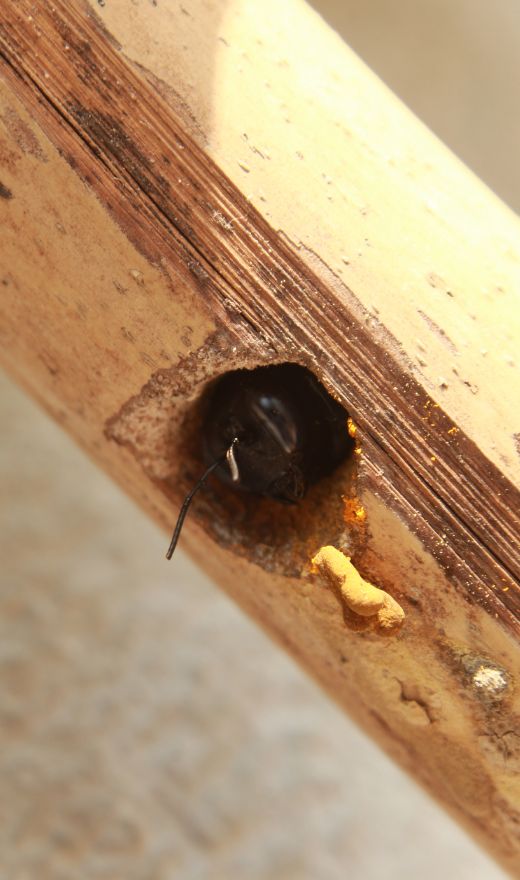
Carpenter Bee
Named after: They have a habit of boring holes into wood like a carpenter’s drill. They are usually ½” and perfectly circular.
Identification: ½”-1,” yellow and black, often mistaken for honeybees, but have shinier and nearly hairless abdomens.
Seasonality: Spring and summer
Why they are in/near my home: They are often seen on front porches due to wood being readily available. They use these holes to lay eggs inside which protects future larvae after hatching.
Tips for homeowners: Use a thick coat of paint or sealant on exposed wood. Fill in holes with wood putty.
How Green Shield can help: They can be a serious threat to the structural integrity of exposed wood like front porches or barns. While their nests look only a few inches deep, they can be up to ten feet long! They also do a fair amount of cosmetic damage. Green Shield is able to treat in extremely hard to reach areas to apply the right product to deter them from future building.
Weird fact: Unlike their cousin, the social honey bee, carpenter bees are solitary creatures. But like the carpenter ant, they don’t eat wood; they excavate it.
Frequently Asked Questions
How can I tell if I have a bee or wasp nest on my property?
Common signs include frequent activity around your home, insects entering and leaving the same location, and visible nests under eaves, decks, sheds, trees, wall voids, or underground. If you notice increased activity, it’s best to have the area inspected by a professional.
What's the difference between bees and wasps?
Some stinging insects are generally rounder and hairier and play an important role in pollination, while others have slimmer bodies, smoother exteriors, and may become more aggressive when defending their nests. Proper identification is important because different species require different treatment approaches.
Should I remove a bee or wasp nest myself?
No. Attempting to remove a nest on your own can be dangerous, especially if the insects become defensive. Professional treatment helps reduce the risk of multiple stings and ensures the nest is managed safely and effectively.
How can I help prevent bees and wasps from nesting near my home?
Regularly inspect your property for developing nests, seal openings around your home, keep garbage containers tightly closed, clean up food and sugary drink spills, and trim vegetation near buildings. Early prevention can significantly reduce nesting opportunities.
Why choose Green Shield Pest Solutions for bee and wasp control?
Our company provides professional treatment using green and safe pesticides to carefully manage stinging insects. Our experienced technicians identify the species, locate nesting sites, apply targeted treatments, and recommend preventive measures to help keep your property protected throughout the stinging insect season.